Sunday, 9 October 2011

Foundation of a dynasty – The ERIBA Touring range - Part 2

It’s not documented whether either major player involved in the original Eriba concept had a penchant for mythology but as demonstrated by the list of original models they mainly used names linked to mythical beings. This trend has continued to the present day. Model names that have been and gone over the 50 years have included the Titan, the Pontos, the Pan and the Odin as well as the Faun.
The relatively rare 660GT Pontos is the only Eriba Touring model without a rear window. Inside there's a fixed double bed with storage underneath


The Titan has not been in production for many years and is the largest model produced by Eriba. One is currently undergoing restoration in the UK near Blackpool.
The present Touring range can be thought of as consisting of:
Puck               2 berth            3.2m or 3.55m long   No washroom
Familia           2/3 berth         3.66m long                 With or without washroom
Triton              2/4 berth         4.21m long                 With or without washroom
Troll                 2/4 berth         4.71m long                 All with washroom
These represent the basic outline details of the Eriba Touring range, but things get a lot more complicated if you decide to delve further. Within each model range there are a number of different layouts for the internals, which affect such things as window and door placement in the outside frame and body. In addition some layouts had further options for things such as fixed double beds in place of pull-out singles and even factory fitted bunk beds.
The availability of this enormous range came to it’s zenith in about 2005 to 2007 with 32 different models and layouts available. After that Eriba started scaling back, deleting layouts and generally trying to reduce what must have been an expensive to maintain parts inventory.
Over the years there have been special editions to celebrate anniversaries and the like or sometimes just because. Around 2006 the Chili special edition was made available with a red Chili logo on the side and red alloy trim on the body plus all the usual silver plastic bits like hitch cover, sidelight fairings, number plate assembly and wheel arches were painted a glorious chilli red with appropriate upholstery fabric inside the van.
A Troll 552GT Chili Special Edition from 2006 with bright red trimmings.
Towards the end of 2008 Hymer launched another special edition range which turned out to have more far reaching consequences than previous offerings. They commissioned Professor Johann Tomforde to carry out a far reaching makeover of the Touring range to take it forward whilst losing as little as possible of its historic design DNA. The result was the somewhat tritely named (as far as the UK was concerned anyway) ‘Forever Young’. It was limited to only a few models but came as quite a shock to conservative Eriba enthusiasts.
A 2009 Troll 530GT 'Forever Young with the shallower roofline which allowed a taller doorway
Visually the FY models went back to an early Eriba paint palette with an all over  pale grey exterior below the roofline. The Troll body was widened by 4”, giving a bigger washroom, plus more legroom for sleeping across the van. The awning rail was raised 4” and the roof given lower profiles. So overall the van was no taller but the head bashing door could be heightened by 4” as was the lower roof inside. Interior furniture was remodelled with lots of sweeping curves and overall there was a feeling of greater space.
The FY’s ran for 2009 Model Year, but when the Touring range was revealed for 2010MY it was plain that FY had totally influenced the latest designs. In were the interior curves and fittings and the extra height and width, whilst FY’s exterior paint scheme was enlivened with a white top half to the body.
In 2011 the formal Touring range consisted of just four models for sale: one layout of Familia, one Triton and a pair of Troll layouts, but all continuing with the ‘FYised’ styling. In 2012 the range has been increased slightly with two Familia, two Triton and three Troll layouts available.
2010MY Troll 530GT with FYised roofline and the white painted top half of the body
Notice there’s no Puck. The tiny van that can arguably be said to be the very touchstone of the Eriba brand is missing from the list. Over recent years there have always been two Puck versions, the tiny 120 and the larger  Puck L or Super Puck which was a bit longer and managed to cram good length single beds into its small frame. However the costs of producing these diminutive vans were very high as they shared very little in the way of parts with their larger brethren. They were quietly dropped from the Eriba range by Hymer France for the 2009 model year without anyone really realising at the time. 
A late model Puck 120GT, the smallest Eriba, which quietly slipped out of production in 2009
Possibly this was because even more startling news emerged soon after when Hymer announced the closure of the Hymer France factory in Cernay, following substantial losses over a number of years. Much to the disappointment of the French workforce, after a period of four decades production was transferred back to Bad Waldsee.
For the following year Hymer announced their much smaller catalogue of models as they set up a new Eriba production line and got to grips with the nuts and bolts of building the vans again. Whether the Pucks and the other lost layouts ever emerge in the future we can only wait and see.
In the next blog we encounter Morpheus and the ins and outs of sleeping in Eribas.

Saturday, 8 October 2011

Foundation of a dynasty – The ERIBA Touring range - Part 1

As mentioned earlier, from the very start of Eriba in 1957/58 it was policy to produce a number of different size vans in a range that would cater for the diverse requirements of potential purchasers. Caravan culture and design were still relatively undeveloped and it was envisaged that a lot of customers would be trading up from camping holidays with very, very few facilities and relatively low expectations. People liked to keep their caravans small to reduce the initial outlay and to be able to store them on drives, in gardens and garages at home and not least to allow them to be towed by the relatively low power cars that were common at the time.
1958 Sprite Caravans advertisement
All sorts of innovative ideas were being tried out by caravan makers throughout the world and to a great extent most new models for any maker were a step in the dark with no idea whether their particular designs would find public favour and profitable sales.
The Eriba designs were unusual, and in many ways unique. They were founded on some of the principles of aircraft design of the time as anyone who has a passing knowledge of planes from the 30’s, 40, and ‘50’s will acknowledge, with a bit of 1950’s current practice car technology thrown in.
Diagram showing Eriba caravan construction and the unique steel tube frame
The shape is somewhat streamlined and owes it’s lines and body strength to an underlying frame of tubular steel to which aluminium sheets are fixed and moulded as body panels. The steel frame provides rigidity which eliminates the panel joint flexing that eventually leads to water penetration on wood framed caravans. The joints between these sheets were covered by various alloy rails to help seal the van and tidily cover the screws and rivets.
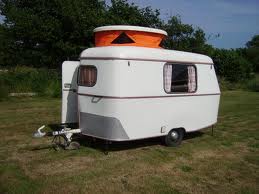
2008 Eriba Touring Puck 120GT
In order to keep the profile of the caravans as low and as aerodynamic as possible Eribas were designed with a pop-top roof, an elegant solution or a pain in the cranium depending upon your point of view. The one piece pop-top is made from glass fibre and clamps down onto a fixed one piece moulded fibreglass main roof that is supported by the van’s steel frame. The use of this unique form of construction is one of the factors that accounts for the longevity of Eribas compared to their competition. The one piece format considerably reduces the possibility of leaks in and around the roof area, so the dreaded damp rarely troubles an Eribista.
1970 Eriba Puck with the circular pop-top roof in the fetching orange shade
Unfortunately reducing the roof height also meant reducing the height of the door frame and this has meant that nearly every person who has owned or camped in an Eriba has clonked their head on the aluminium door frame at some time or the other. This rite of passage has become known as the ‘Eriba Kiss’ and veterans proudly point to the line of bruises on their forehead as a badge of honour. I jest of course, but it is true that the frame can fetch you a nasty whack, dependant on your height and your velocity through the doorway. I don’t think this is what the designers meant by ‘aeronautically influenced’, but having seen some of the hatches that WWII aircrews used then, one begins to wonder. In fact you soon adapt and find the required automatic crouch that suits and allows you to exit without injury, but not exactly with total elegance.
In the absence of a photo of an Eriba doorway here's Poppy's door showing the useful storage, but beware, the shelf retainers won't take too much weight and light items can get blown off the shelves.
Inside the caravan there’s little to mark the interior as something out of the ordinary apart from the obvious inside of the pop-top, with its flexible canvas protective outer ‘skin’ and it’s interior net covering. With the top popped people over 6ft tall fit comfortably inside, that is unless they inadvertently forget to duck at either end of the van, where the roof resumes its lower level.
The fitted internal furniture has always been built to a good standard, with pleasing, if not exactly avant garde finishes. The upholstery fabrics are strong enough to stand up to the environment involved whilst not being exactly cutting edge design. In fact with such a long ‘back catalogue’ it’s inevitable that some interiors will look dated, but compared to fabrics used by UK constructors at similar dates the Eribas happily lose out in the embarrassing patterns contest.  
A typical UK built 1980's caravan interior
There are further details on the Touring range in the next blog

What’s in a name – When is an Eriba an Eriba?

This is where, for a short while, we get into semantics I’m afraid and where I risk upsetting a few people by trying to answer the question ‘What is an ERIBA?’.
Initially there was only one type of Eriba, they were caravans. Later on as Hymer built their motorhome market presence it was decided to produce an Eriba motorhome and so evolved the Eriba Car and Eriba Jet etc. At first these were definitely Eriba, just one look would tell you. They were, not to be impolite, Eriba caravans tacked on the back of a chassis cab from various van makers, especially Renault. The back half looked Eriba, the inside reeked Eriba and, of course, there was the signature pop-top roof.    
An early Eriba Car campervan on a Renault chassis, with pop-top
However more recently it seems to me that Eriba motorhomes have lost their Eribaness. They have quite simply become Hymer clones. They are Hymer motorhomes with different badges and logos and alternative furnishings, but they are most definitely a Hymer. The Eriba pop-top type roof has gone as have a lot of the little design references. Regrettably they’ve been homogenised, although I’m sure that for their owners they’re much more comfortable and luxurious as a result.
A recent Eriba Jet motorhome, its Hymer heritage evident in its every line with token Eriba badging and coloured panels.

So having upset Eriba motorhomers I’ll now do the same to some caravanners.
Around the middle of the 21st century’s first decade Hymer decided to launch the Eriba Feeling caravan range. This range can be best described as a compromise (and I don’t mean this in an insult in any way) between the traditional Eriba caravan and what has become the accepted normal European straight sided white box caravan. For all the world it looks like a standard Euro type van, but with a lower roofline and an Eriba pop-top. Inside the opportunity has been taken to liven up the décor and modernise the furnishings and layout. 
An Eriba/Hymer Feeling with pop-top
They are excellent vans and if the original type Eriba was dead they’d be worthy successors. However recently I’ve noticed that there’s no reference to ‘Eriba’ in the Feeling’s livery and its brand badges read ‘Hymer’ so for this blog’s purposes I’m sorry but the ‘Feeling’ isn’t an Eriba. I’m sure there’s a pun in there somewhere but I’m not even going to try and find it.
Now before the relatively few Feeling owners (well few in the UK anyway) go apoplectic I’ll hasten to say that a lot of what’s contained in this blog is equally applicable to the Feeling range and a lot of other caravans as well, it’s all good stuff. 
The recently launched Hymer Feeling 325. The layout of an Eriba Puck L inside a gorgeous looking, neatly proportioned Feeling body.
 For our purposes we’re focussing on the Eriba caravan as originally designed and their direct descendants, which have been known for quite a while as the Eriba Touring range. Oh and don’t get confused about the ‘GT’ title used when describing some Eriba Tourings, it seems that they’re virtually all called ‘GT’, well ever since around the year 2000 when the external gas locker poking out the front disappeared and a new more streamlined shape appeared with the gas locker built inside the front of the van. Strictly speaking vans from before then weren’t ‘GTs’ and the updated versions from 2010 seem to have lost the magic two letters as well. Probably a good thing too, as in my mind I can’t help linking the term ‘GT’ with old Mark 2 Ford Cortinas and Ford Corsairs, Mark 1 Ford Escorts etc from the ‘70’s, although of course there’s always the sublime Ford GT40 Le Mans winning cars that redresses the balance.
The iconic shape of the Ford GT40 I just had to include it, what a stunner.
In the next blog we look in more detail at the Touring range

Thursday, 6 October 2011

How it all started - Was there ever a world without ERIBAs? Part 2

Erwin Hymer was born in 1930 in Bad Waldsee and was 24 years younger than Erich Bachem. He studied mechanical engineering and initially started work with the Dornier aircraft company, in Spain where he helped design the successful Do27 short take-off and landing single engine aircraft. 
A Dornier Do27
Later he moved with Dornier to Munich and of all things designed bubble cars for them.
A Dornier Janus bubblecar
In 1956 Hymer moved back to Bad Walsee to join his father’s car business. At about the same time his father bought some land from their neighbour, Erich Bachem, to extend his premises. Bachem had actually designed a caravan for his own use and asked Hymer senior to produce it for him. Erwin was put in charge of the project by his father and it was this decision to put the two experienced aeronautical engineers with knowledge of vehicle and caravan design together that still resonates today.
A late '60's Eriba Puck
The initial prototype caravans were built in 1957 and tested by both families during their summer holidays, with production starting in 1958. The Puck Luxus, Faun Standard and Faun Familia were produced by Hymers at Bad Waldsee and the Troll Luxus range topping van was contracted out to glider maker Schempp-Hirth, surely a throwback to Bachem’s Aero Sport experience from the ‘30’s.
The first year’s production was 167 vans, followed by 455 in 1959 and then on into the thousands.

In 1961, a year after Bachem’s death, Hymer diversified further, moving into motorhomes using a Borgward chassis and Eriba-like pop-top. Unfortunately Borgward ceased trading in 1962 and Hymer decided to drop the motorhome project and concentrate on caravans. 
A Hymer Borgward Campervan from 1961
During the ‘60’s they brought Troll production in-house and launched the Nova range of caravans, whilst gradually developing and modernising the Eriba range. They also diversified into alloy ladder production and caravan components. Production volume rose to 1,500 vans a year with the 10,000 van milestone being reached in 1966.
In early 1968 fire swept through the Bad Waldsee factory, destroying all but the cabinet production area and offices, but full production in enlarged buildings was back in operation by June of the same year.
In 1970 Hymer France was set up at Thann, Alsace and moved two years later to a brand new factory in Cernay where Eriba caravans were produced until early 2010. With most caravan production moved to France it was time for Hymer to get back into the motorhome market. 
The offices at Hymer France factory complex in Cernay

Part of the production buildings at Hymer France

Hymer launched their second assault on the motorhome market in 1971 when a total of only 701 motorhomes were registered in Germany but by the end of the decade that figure was 4,750 a year.

A 1971 Mercedes based Hymer 555 motorhome
In 1973, after the death of his father, Erwin Hymer became head of the Hymer company, and in 1978 he also took over the top job at Eriba following the death of Eric Bachem’s successor in a road accident. In 1980 the two companies were formally brought together under the Eriba-Hymer GmBH banner. 
A small part of the immense Hymer plant at Bad Waldsee
Over the intervening years Hymer Group has grown enormously with its name being inextricably linked and synonymous with their highly regarded range of motorhomes. In 1990 after suffering a health problem Erwin decided to turn the Group into a publicly owned company with himself as majority owner and chairman of the supervisory board. As it has developed and the years have passed the Group has acquired ownership of many other brands including Burstner, Carado, Laika, Niesmann & Bischoff, Dethleffs, Sunlight, LMC, TEC and the accessory company Movera.
Erwin Hymer has celebrated 50 years of the Hymer Group. Here he's standing in front og one of the oldest and one of the newest eponymous motorhomes.
Despite reducing his involvement with the business Erwin Hymer at 81 years old can still be found in his office in Bad Waldsee on an almost daily basis and on his wall behind his desk is a picture of that very first Eriba from 1957.
Erwin posing in front of the museum that bears his name in Bad Waldsee, it's due to open at the end of October 2011
In the next blog I'll explain the Eribas that the blog is about and I suspect I'll upset some people in the process.

Wednesday, 5 October 2011

How it all started – Was there ever a world without ERIBAs? Part 1


Before you write anything about Eribas you have to understand a little of the history and personalities behind what is known these days as a brand.
It’s difficult to really identify which of two people who were instrumental in the initial setting up of Eriba had the most overall influence on the project. The involvement of both Erich Bachem and Erwin Hymer was closely interwoven during those first few years.  By all accounts Bachem did the majority of designing of the original caravans and lent his name to them (ERIch BAchem). Thank goodness they didn’t make the other choice and use Erwin’s name in a similar manner, somehow I don’t think an ERWHY would have done so well.
Sadly Erich Bachem died shortly after production commenced and it was Erwin Hymer and his father who ensured that the name lived on and that the product continued true to its designers ideals.
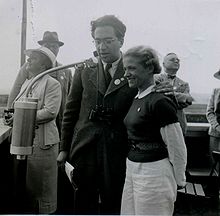
 Erich Bachem with Hanna Reitsch the 'celebrity' female pilot  
Erich Bachem was born in 1906 in Mülheim an der Ruhr and became an aeronautical engineer, involved in designing sailplanes. During the 1930’s he also designed a camping trailer made out of wood called the Aero Sport, it was built by the glider manufacturing company Wolf Hirth. 
 
 The Fiesler Storch
During the Second World War Bachem initially worked for Fieseler and co-designed their most famous product, the Fieseler Storch (Stork), a short take-off and landing single engine observation and liaison aircraft which does indeed bear an uncanny resemblance to the bird it was named after. He also worked with Werner von Braun on the design of a twin jet vertical take-off fighter, but the Government shelved the design as too big and too heavy.
 A Bachem BA349 Natter (Viper or Adder) in a US museum
 In 1942 he set up his own company which initially built spare parts for piston engine aircraft. Later in 1944, with Germany under tremendous pressure from relentless Allied heavy bombing, he designed a vertical take-off rocket powered interceptor under SS sponsorship. The Bachem Ba349 Natter can be said to be the forerunner of all surface to air missiles that followed. With a wooden fuselage and high power rocket motor, plus booster rockets strapped round the outside it didn’t need an airfield to launch and was guided by radio for the most part, to allow inexperienced pilots to be used to fly it. The idea was to blast up towards the Allied bombers at high speed under radio control. Once within range of the bombers the boosters and the plane’s nose cone would be jettisoned and the pilot would manoeuvre and fire a salvo of rockets fitted in the nose. After that the pilot was supposed to bail out and return to earth by parachute as his plane crashed without him.
Thirty six Natters were built, of which about half we’re flown in testing, mainly by air launching them as gliders from a larger aircraft. On the 1st March 1945 the first and only manned, powered test flight took place with the SS anxious to get results from their project. Unfortunately the plane crashed and the pilot was killed within seconds of launch and the whole programme was quietly dropped.
After the war Bachem settled in Bad Waldsee, Barden-Wurttemberg, southern Germany and eventually in 1957 started working with his neighbour Erwin Hymer developing designs for caravans. Production started in 1958 with Hymer’s factory producing the vans and Bachem’s company running the marketing and sales and it was at that point that the brand Eriba became a reality.
Unfortunately Erich Bachem died two years later in 1960, at the comparatively young age of 54, just as the diminutive campers were starting to become popular.

There's more about how Eriba started, Erwin Hymer and the Hymer Group in the next blog.

Tuesday, 4 October 2011

Eriba Living

Caravans get a bad press and lets be fair, if you’re wanting to push on down the M5 past Bristol on an August Saturday with the Mrs feeling frazzled and your brood on the back seat threatening simmering rebellion, the sight of a long hill with two solid inside lanes of Mr Smith’s finest products out of Cottingham, limited to 60 and some struggling to keep up 40, you will not feel kindly towards them. It’s understandable.
But let’s forget the lemming like summer migration to the West Country and consider some altogether different journeys, trips that take you through a voyage of discovery. Journeys that will tell about European social history over the last 50 years, journeys that illustrate inventiveness and a determination to be different, that facilitated holidays for thousands and defied all the accepted norms of leisure vehicle construction. Whilst ‘normal’ caravans went along the route of timber construction with all the risks and problems of rot and delamination caused by north European dampness one name shone out from the 1950’s onwards, with their unique steel framed caravan bodies covered in aluminium panels. That name was Eriba, designed by a German, but manufactured in north eastern France for 40 years and the very antithesis of the enormous shiny US Airstream cigar tubes for which they are often mistaken. 
 Our journeys will trace the history and development of Eriba. We’ll visit the birthplace in Germany and the, so sadly recently closed, French factory at Cernay. We’ll meet the people who screwed Eriba together for so many years; we’ll hear their stories and their memories of a unique product and what it was like to be a member of the Eriba family. We’ll visit the UK Eriba dealerships,   journeying up to Scotland to meet Sandy and Jean the owners of Scotland’s official Eriba dealership and we’ll cruise down to Poole to meet someone who’s built a very successful business importing used Eribas for sale in the UK and who is now England's official dealership. And we’ll meet the Eribaists, the Eribaistas, the Eribae, the Eribanauts, the enthusiasts, the people who’ve taken the little vans to their hearts and treasure them for their idiosyncrasies and for the values they represent. The people who take these caravans, old and young, from 2 berths and no loo through to 4 berth and a proper washroom. From bare European spec. caravans with no hot water or interior heating through to new high spec. Eriba Jet motorhomes with every imaginable luxury . 
The contrasts and values embodied in Eriba are unique and the difference between owning an Eriba and an Elddis, a Bailey, a Swift, a Lunar or Coachman product are evident just by taking one glance. Eriba speak of times past, but with modern facilities, they speak of adaptability with their pop-top roofs, they hark back to less stressful times, but have a happy knack of being able to cope with anything that the modern world can throw at them. Practically they tow like a dream, slim and elegant, low and streamlined there’s nothing out of scale or over the top about an Eriba. 
These journeys will visit the very best campsites en route and discover the joys of caravanning in the 21st century in a van originally designed in the middle of the 20th century. Looking at landscapes, villages and towns along the way at local unique attractions and specialities, at campsites and tourist sights that are both stunning and a cause for wonder.
Above all that is what Eriba are all about 

That's the intro to the blog, on the next page we look at some of the history of Eribas.